Newsletter Issue No. 009 · Wednesday 4 November 2026

DIESEL INDUSTRY NEWS

The world's diesel industry, verified.  |  dieselindustrynews.com
Proudly brought to you by Berrima Diesel Service, on the tools and educating generations since 1956
From the Editor's Desk

This week's cover belongs to Chery, whose chief engineer has finally put hard numbers and a straight engineering argument behind the Stockman, Australia's first diesel plug-in hybrid ute. Desk 1 carries five Australian and New Zealand stories this issue, including fresh data on just how comfortably diesel is still beating Toyota's own petrol-hybrid LandCruiser. It's also the first Wednesday of the month, so Australia Needs Mechanics returns with fresh figures on just how much bargaining power a young tradesperson has right now. Bob, Editor

Back to the Diesel Industry News homepage
Stop Press: the last 48 hours

Russia quadruples the diesel it will actually let leave the country

Moscow has signed off on extending its diesel export ban through January 2027, but Deputy PM Alexander Novak says the quota let out under exceptions jumps to around 2.15 million tonnes in November, more than quadruple October's level, tied to a US supply deal struck after a Putin-Trump call.

Toyota South Africa confirms a GR Sport flagship for the next HiLux

Toyota South Africa Motors boss Andrew Kirby told Naamsa's SA Auto Week the ninth-generation HiLux will get a GR Sport diesel flagship, the first on-record confirmation the hot variant survives the facelift.

NZ's October market jumps 10 per cent, HiLux reclaims top ute spot

New Zealand Transport Agency data shows the HiLux back ahead of the Ranger with 872 registrations to 805, while diesel mild-hybrid commercial registrations jumped 49 per cent to 621 units for the month.

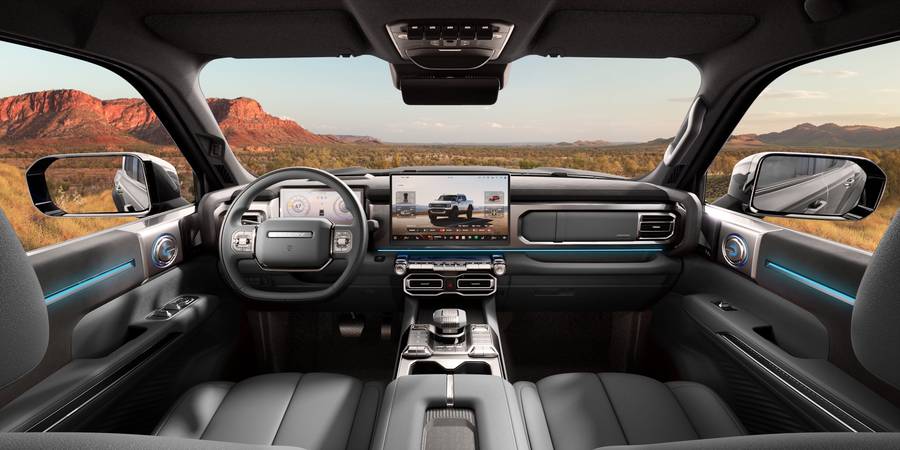
Front Cover · Diesel-Hybrid Feature · Issue 009
Chery's Own Chief Engineer Spells Out Why The Stockman Is Diesel, Not Petrol
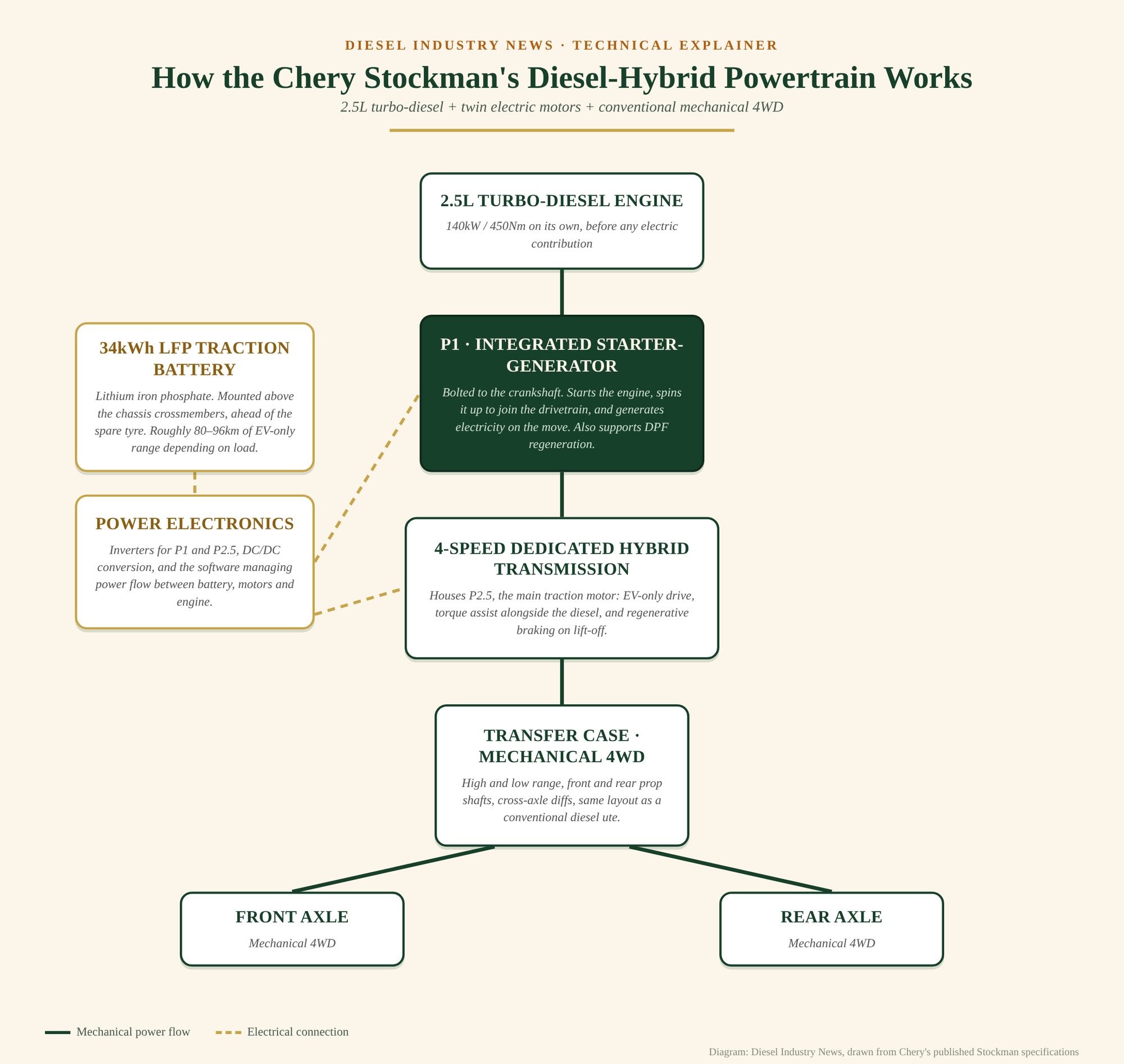
Diagram: Diesel Industry News, drawn in-house from Chery's own published Stockman specifications

Chery's Own Chief Engineer Spells Out Why The Stockman Is Diesel, Not Petrol

The clearest engineering case yet, from Chery's own chief engineer rather than marketing copy, for why Australia's first diesel plug-in-hybrid ute is diesel at all, with the firmest numbers released so far.

Speaking to Australian and NZ media at Chery's Wuhu facility, Stockman chief engineer Mark Qi laid out the engineering case for a diesel plug-in hybrid dual cab: diesel accounts for over 90 per cent of ute sales in China, South Africa and Brazil, and keeps the rear wheels mechanically driven for towing and steep climb traction, unlike BYD's front driven petrol Shark 6, which Qi called "useless" on a steep climb once weight shifts rearward. He puts electric assist at roughly 30 to 40 per cent of the drivetrain's work, calling it "the helper, not the main thing."

The firm numbers: a 2.5 litre turbo diesel making 140kW/450Nm on its own, a 34kWh battery, 96km of WLTC electric only range, and 350kW/800Nm combined, plus an explanation of how the P1 motor manages DPF regeneration so "a normal user won't even feel it." Qi has also confirmed the Stockman's ladder frame platform was designed from the outset to accommodate a full size SUV/wagon body too, though no SUV variant has been greenlit. NZ arrival is Q1 2027, after February 2027 Australian deliveries.
Folds together two separate manufacturer interviews with the same chief engineer, plus new platform detail on a possible future SUV sibling, rather than running them as duplicate stories.
HYBRID LEVEL: PLUG-IN / PHEV: 2.5L turbo-diesel retained, 34kWh battery, 96km WLTC electric-only range, 350kW/800Nm combined.
Chery's Own Chief Engineer Spells Out Why The Stockman Is Diesel, Not Petrol
Image: Chery New Zealand
Primary source: Auto Trader NZ & GoAuto · 26–28 October 2026
Back to the Diesel Industry News homepage
Desk 1 · Australia & New Zealand The Home Desk

Australia's $9 Billion Diesel Import Bill Is Double Any Other Country's, Climate Council Warns

Puts a hard dollar figure on Australia's exposure to imported diesel just as the industry debates fuel security, excise policy and electrification.

Australia spent roughly $9 billion importing diesel between March and August 2026, during the period of the US/Israel action against Iran, more than double any other country's bill over the same stretch, according to new Climate Council analysis. The country remains the world's biggest seaborne diesel importer, bringing in around 90 per cent of what it uses, with consumption now two and a half times 2000 levels.

Climate Councillor and economist Nicki Hutley said relying on imported oil means leaving our energy security in someone else's hands, and that the bill feeds straight into local inflation. Former BP Australasia president Greg Bourne, also a Climate Councillor, put it bluntly: this one isn't over, and it won't be the last.
Primary source: Energy Source & Distribution · 28 October 2026

Oil Spike Wipes Out Australia's Excise Relief, Diesel Set To Climb Again

Brent crude's push to a six month high, with no repeat of the earlier fuel excise cut, means diesel and petrol are both heading up again.

Australian bowser prices look set to rise again after Brent crude hit US$117.35 a barrel this week, its highest in six months and within reach of April's war-driven peak of US$118.03. Unlike that first spike, there is no government relief this time: the 32 cents a litre fuel excise cut that ran from April to August has not been repeated.

CarsGuide reports 91 RON petrol in NSW averaged 237c a litre as October closed, up from 168c in February, and could reach 250c by mid November. Diesel prices will follow the same oil move. Federal reserves sit at 31 days of diesel, unchanged since March, which suggests the squeeze is on price rather than supply right now.
Primary source: CarsGuide · 29 October 2026

Hyundai Narrows Its Ute Plan To Two Rival Global Models, Flags Possible 4WD Wagon Too

Hyundai is the last major mainstream brand without a dual-cab ute in Australia, and its first move into the segment could reshape where buyers put their diesel dollars from 2028.

Hyundai Australia has told CarsGuide it is down to two candidates for its long-awaited Ford Ranger and Toyota HiLux rival. One is the premium option, previewed by the US-market Boulder concept, which chief operating officer Gavin Donaldson says could also spin off a proper ladder-frame 4WD wagon to take on the Pajero, Prado and Everest. The other leans on an updated version of the Kia Tasman, which Donaldson calls the faster path to market.

He is betting on "a hybrid engine of some sort" for the eventual ute, but won't rule anything out if another powertrain gets it to showrooms sooner, leaving the door open for the Tasman's existing 2.2 litre turbo diesel. Nothing lands before 2028 at the earliest.
Primary source: CarsGuide · 2 November 2026
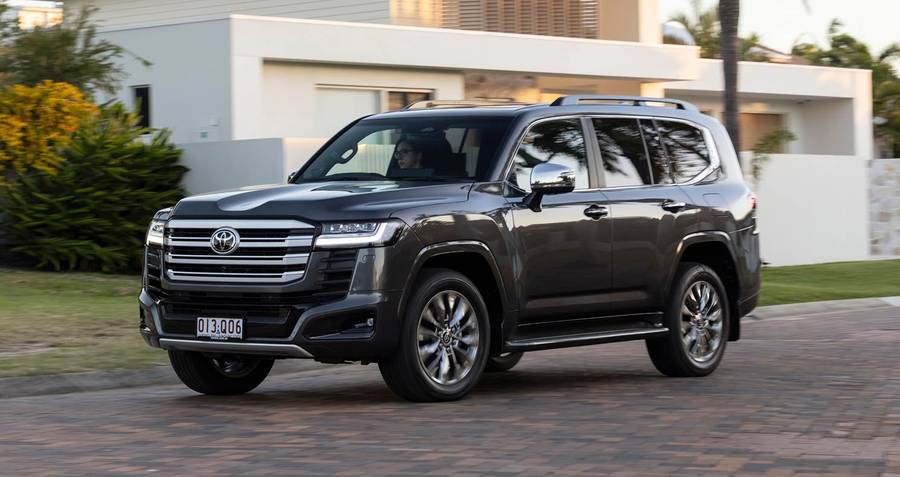
Toyota's LandCruiser 300 Diesel Is Outselling Its Own Petrol-Hybrid Seven To One
Image: Toyota Australia

Toyota's LandCruiser 300 Diesel Is Outselling Its Own Petrol-Hybrid Seven To One

Australia's most important big diesel wagon shows buyers overwhelmingly still want the oil burner over Toyota's petrol-hybrid “Performance Hybrid”.

Toyota has shifted 9,787 LandCruiser wagons in the first nine months of 2026, up over 10 per cent on last year, as the ageing Nissan Patrol Y62 gets run out ahead of its early 2027 replacement. The 300 Series Performance Hybrid, a 3.5 litre twin-turbo V6 petrol paired with an electric motor making 341kW/790Nm, accounts for only about 15 per cent of LC300 sales, which Toyota says is exactly what it expected.

The 3.3 litre twin-turbo diesel keeps mopping up the rest, outselling the hybrid nearly seven to one despite the hybrid's extra grunt, because it is cheaper and buyers still trust it for towing and long-haul work. Both powertrains now sit above the NVES emissions threshold, so Toyota has flagged more price rises could be coming.
Primary source: CarsGuide · 3 November 2026
Toyota HiLux Overtakes Ford Ranger Again As NZ's October New-Vehicle Market Jumps 10 Percent
Image: Toyota New Zealand

Toyota HiLux Overtakes Ford Ranger Again As NZ's October New-Vehicle Market Jumps 10 Percent

New Zealand's equivalent of VFACTS gives the first clean read on how diesel utes and diesel mild-hybrids are actually tracking against the EV/PHEV surge there.

NZ Transport Agency data shows new passenger registrations up 10.5 per cent year on year to 11,824 in October, the strongest October since 2019, while commercial registrations slipped 5.9 per cent to 3,285. The HiLux reclaimed top spot in the ute fight with 872 registrations against the Ranger's 805, reversing last October's order, with the Triton and BYD Shark 6 well back.

Diesel still accounts for roughly two thirds of commercial registrations even though straight diesel volume fell 20 per cent, and diesel mild-hybrids jumped 49 per cent to 621 units. On the passenger side, plug-ins made up about a quarter of the market, up from under 10 per cent a year ago, while straight diesel passenger sales fell 43 per cent to just 623.
HYBRID LEVEL: Diesel mild-hybrid (MHEV) commercial registrations referenced, per NZTA's own classification for 48V-style start-stop/assist systems.
Primary source: Auto Trader NZ · 1 November 2026
Australia Needs Mechanics · a monthly page for the next generation
Australia Needs You: Become a Mechanic poster
Artwork: Berrima Diesel Service

Australia needs you: there has never been a better time to pick up the spanners

Every workshop in the country is looking for the next good mechanic. The work is there, the vehicles are there, and the demand for skilled hands has never been higher. Here is the honest state of play, and why a trade under the bonnet is one of the surest careers in Australia today.

Walk into almost any workshop in Australia and ask the boss what keeps him awake at night. It won't be the price of parts. It will be finding people.

The numbers back him up. Industry research commissioned by the Australian Automotive Aftermarket Association put the national gap at more than 40,000 workers, roughly 27,000 qualified technicians and 13,500 apprentices, and the trade bodies have called the skills shortage the industry's most pressing issue ever since. Fresh figures from the Motor Trades Association of Australia's 2026 member survey, reported this week, show just how sharp that squeeze has become: the average number of applicants per advertised vacancy has collapsed from 8.2 in 2024 to just 3.0 this year, with more than nine in ten employers calling recruitment difficult or very difficult, and 38 per cent of advertised positions still unfilled.

That is a problem for the industry. For a young person choosing a career, it is the opposite. Scarce skills call the shots. A qualified technician today can choose the workshop, choose the town, and negotiate.
THE WORK IS NOT GOING ANYWHERE. Electric vehicles are around one in ten new-car sales in Australia, which means nine in ten new vehicles rolling out of showrooms this year still run on petrol or diesel, and they will need servicing, diagnosis and repair for the next fifteen to twenty years. Every diesel ute, every farm tractor, every truck, boat and generator in the country is a job waiting for someone with the skills. And the EVs need people too: high-voltage systems, battery diagnostics and software-heavy vehicles are creating a second career path that barely existed a decade ago. Whichever way the market turns, the mechanic wins.

THE PIPELINE NEEDS HELP, AND IT'S WORTH SAYING WHY. Official figures from the National Centre for Vocational Education Research show that about 62 per cent of automotive and engineering apprentices finish their trade within six years. That is actually the best result in more than a decade, but it still means close to four in ten never get their ticket. When apprentices are asked why, the answers are consistent: low first-year wages while the cost of living climbs, thin mentoring, and long, expensive commutes to training. In an AAAA survey of 600 automotive apprentices, 69 per cent named living costs as their biggest challenge.

Then, on 1 January this year, the Federal Government halved the two main apprenticeship payments for trades on its Priority List, the employer's Priority Hiring Incentive and the apprentice's Training Support Payment, each dropping from $5,000 to $2,500. Anyone who started before New Year keeps the old rate; anyone starting now gets half. A new $5,000 "Key Apprenticeship Program" incentive was created at the same time, but it covers clean-energy and housing trades, not motor mechanics. The Motor Trades Association of Australia said plainly that cutting the incentives that make apprenticeships viable "will only compound this crisis."

SO WHAT DOES A GOOD FUTURE LOOK LIKE? It looks like a small family workshop, part of a family of diesel experts since 1956, now teaching the third generation. It looks like a first-year apprentice who is scared of a common-rail injector in March and pulling and testing one unsupervised by Christmas. It looks like a trade that cannot be sent offshore, cannot be replaced by an app, and gets more valuable every year the shortage continues.

If you are a school leaver, a parent, a career adviser, or someone in their thirties wondering whether it is too late, it isn't. Australia needs you. Help keep Australia moving.
Scarce skills call the shots. A qualified technician today can choose the workshop, choose the town, and negotiate.
FACT BOX: THE STATE OF PLAY
  • Industry shortfall: 40,000+ technicians and apprentices (AAAA / Fifth Quadrant research)
  • NEW: automotive applicants per advertised vacancy collapsed from 8.2 (2024) to 3.0 (2026); 90%+ of employers call recruitment difficult or very difficult; 38% of advertised positions remain unfilled (MTAA 2026 member survey, reported 3 Nov 2026)
  • One in three workshops has a technician vacancy open 6+ months (VACC, Nov 2025)
  • Automotive apprentice completion: 61.9% within 6 years, best since 2012 (NCVER, 2025)
  • 69% of auto apprentices say cost of living is their biggest challenge (AAAA survey of 600)
  • Apprenticeship incentives halved 1 Jan 2026: $5,000 to $2,500 (employer and apprentice payments)
  • EVs about 10% of new-car sales; petrol and diesel about 90% (MTAA, Dec 2025)
THIS MONTH IN THE TRADE
  • The squeeze shows up in black and white: the Motor Trades Association of Australia's 2026 member survey, reported this week by GoAutoNews Premium, found the average number of applicants for every automotive vacancy has fallen from 8.2 two years ago to just 3.0 now. VACC chief executive Peter Jones says the shortage keeps deepening, which is exactly why a new apprentice walking in the door today starts with more bargaining power than almost any generation before them.
  • TAFE NSW has put $2.5 million into a heavy-vehicle upgrade at its Wetherill Park campus in Western Sydney, adding a covered outdoor learning bay for heavy-vehicle dismantling and assembly, upgraded engineering grinding rooms, and a donated hydrogen prime mover for hands-on teaching. NSW Skills Minister Steve Whan says road freight demand is projected to grow 80 per cent by 2050, with almost half the state's vehicle body builders already aged 45 or over, which is exactly the gap new apprentices are needed to fill.
Advertisement
Pocket Tuner
Back to the Diesel Industry News homepage
Desk 2 · Road Vehicles & Performance
See this week's cover story above: Chery's own chief engineer on why the Stockman is diesel, not petrol.
Isuzu Confirms Thailand-Only Bi-Turbo Diesel Won't (Yet) Come To Australia
Image: Isuzu Ute Australia

Isuzu Confirms Thailand-Only Bi-Turbo Diesel Won't (Yet) Come To Australia

The first on-record Isuzu Ute Australia statement since the fuel-type saga went quiet, and it's a direct no, not a hedge, on the new engine everyone assumed might be the answer.

Isuzu has revealed a new 2.2 litre four-cylinder bi-turbo diesel for the D-Max and MU-X in Thailand, making 150kW/500Nm, up on both engines currently sold in Australia and claimed to be about 5 per cent quicker to 100km/h and 8 per cent more fuel efficient. Isuzu Ute Australia has explicitly ruled it out locally for now, telling CarsGuide the engine "is currently specific to the Thai market" with "no announcements to make regarding this powertrain for Australia at this time."

No hybrid or PHEV version was mentioned. It matters because both current Australian engines already exceed the 2026 NVES Type 2 target of 180g/km CO2, which tightens to 150g/km in 2027, so Isuzu's fine exposure grows regardless of which diesel it eventually picks.
Primary source: CarsGuide · 26 October 2026

Stellantis Confirms December Modena Event Is “Maserati Day”, Not A Ducato Diesel-Hybrid Reveal

Resolves a mix-up running through trade press: the Ducato diesel-hybrid programme and the Maserati industrial relaunch are two separate Stellantis stories that had been getting tangled together.

Stellantis's own 28 October third-quarter results statement names the long-rumoured 10 December Modena event "FaSTLane 2030 / Maserati Day," confirming it covers Maserati's industrial relaunch and the knock-on effects for Cassino's passenger-car lines. Neither Stellantis's own release nor Italian wire reports on it mention the Ducato, Boxer, Jumper or any van.

The real diesel-hybrid van story sits elsewhere: Italian unions told trade press in mid-October that Stellantis has authorised trials of a diesel-hybrid powertrain at its Pratola Serra engine plant, destined for the next-generation Ducato due around 2028, with mass production pencilled in for mid-2029 at the earliest. A Stellantis spokesperson confirmed only that the programme is "still in a testing phase," with no battery, voltage or electric-range figures released.
HYBRID LEVEL: UNCONFIRMED: described only as “diesel-hybrid”, no MHEV/HEV/PHEV classification, battery size or electric range disclosed yet.
Primary source: Stellantis Newsroom & ANSA · 28 October 2026
Toyota South Africa Boss Confirms A GR Sport Flagship Is Coming For The Next HiLux
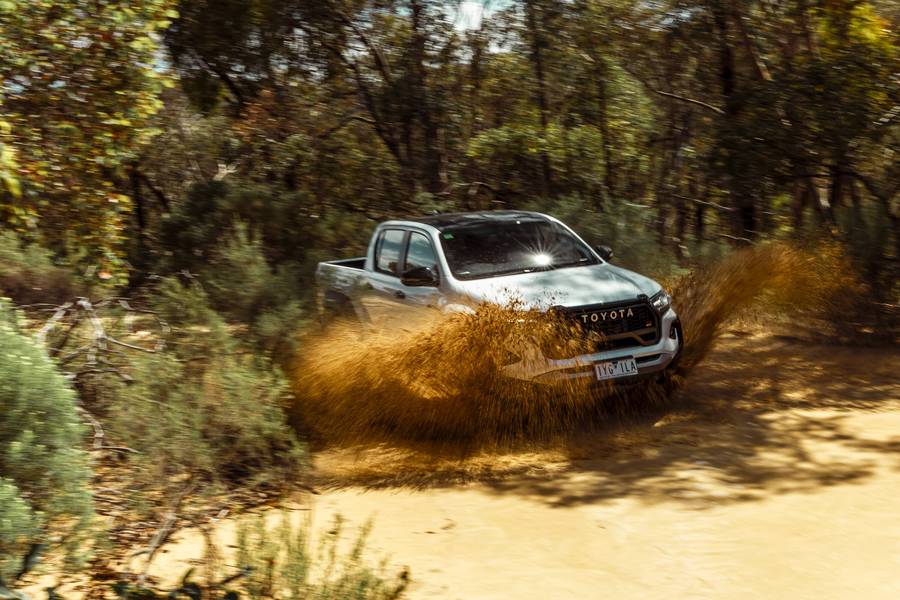
Image: Toyota Australia (outgoing GR Sport shown)

Toyota South Africa Boss Confirms A GR Sport Flagship Is Coming For The Next HiLux

The first on-record confirmation from inside Toyota that the hot diesel HiLux variant lives on into the new generation, even though its home market and diesel specs are not locked yet.

Toyota South Africa Motors president and CEO Andrew Kirby told local trade press at Naamsa's SA Auto Week 2026 in Durban that the ninth-generation HiLux range will get a GR Sport flagship, the first real confirmation the badge survives the facelift. The outgoing GR Sport ran an uprated 2.8 litre turbo diesel putting out 165kW/550Nm against the standard ute's 150kW/500Nm.

The expectation is the new one keeps a similarly hot diesel tune alongside the six-speed auto and 4x4 driveline, plus the usual widebody kit, bespoke suspension and GR cosmetic upgrades. None of the technical detail is locked in yet, Toyota has not revealed the vehicle, and a South African launch is tipped for sometime in 2027.
Primary source: Cars.co.za via 4X4 Australia · 2 November 2026
Back to the Diesel Industry News homepage
Desk 3 · Trucking, Agriculture & Heavy Industry
MAN And Claas Start Three Year Push To Get Ammonia Into Farm Machinery
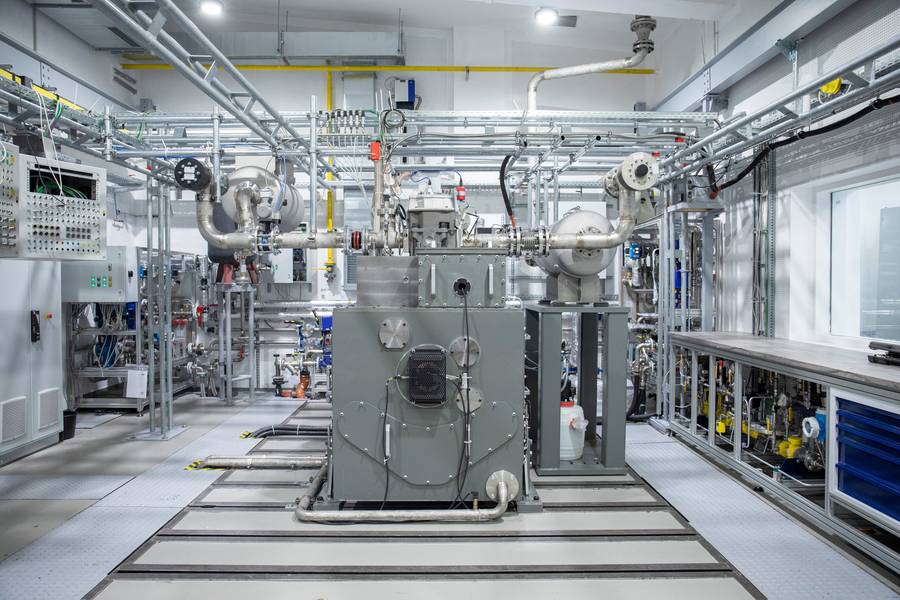
Image: WTZ Rosslau, Germany

MAN And Claas Start Three Year Push To Get Ammonia Into Farm Machinery

A German government-backed project puts a major diesel engine maker and a top combine harvester builder in the same room to test whether ammonia can do the job diesel does in heavy ag equipment.

MAN Engines has kicked off a research project with combine harvester maker Claas and test house WTZ Rosslau to find out whether ammonia, which carries no carbon, can power heavy farm machinery that needs to run flat out for long hours and switch tasks without notice. The project, GAMCO, is funded by Germany's economics ministry and runs to October 2029.

Right now it's single-cylinder bench testing at WTZ Rosslau, with no power or efficiency figures released yet. MAN's engineering chief Werner Kubler says decarbonising heavy off-road machinery won't come down to one technology.
Primary source: MAN Truck & Bus · 27 October 2026
Hitachi And Yanmar Strike First North American Compact Equipment Supply Deal
Image: Hitachi Construction Machinery / Yanmar, Japan

Hitachi And Yanmar Strike First North American Compact Equipment Supply Deal

Two major diesel compact-equipment makers are now building each other's machines in the US, a real structural shift in who builds what in the sub-10-tonne construction segment.

Hitachi Construction Machinery and Yanmar Holdings have launched the first official programme under their July letter-of-intent partnership. Yanmar will manufacture compact track loaders in Grand Rapids, Michigan, for sale through Hitachi's Americas division, badged under Hitachi's upcoming "LANDCROS" rebrand, with sales starting fall 2027.

Hitachi's Masafumi Senzaki cited a North American compact track loader market exceeding 100,000 units a year as the rationale. A reciprocal arrangement will see Hitachi supply compact excavators sold through Yanmar's US dealer network.
Primary source: mining.com · 28 October 2026
Liebherr Confirms Ten-Machine Diesel Mining Fleet Now Fully Delivered To Indonesia's Darma Henwa
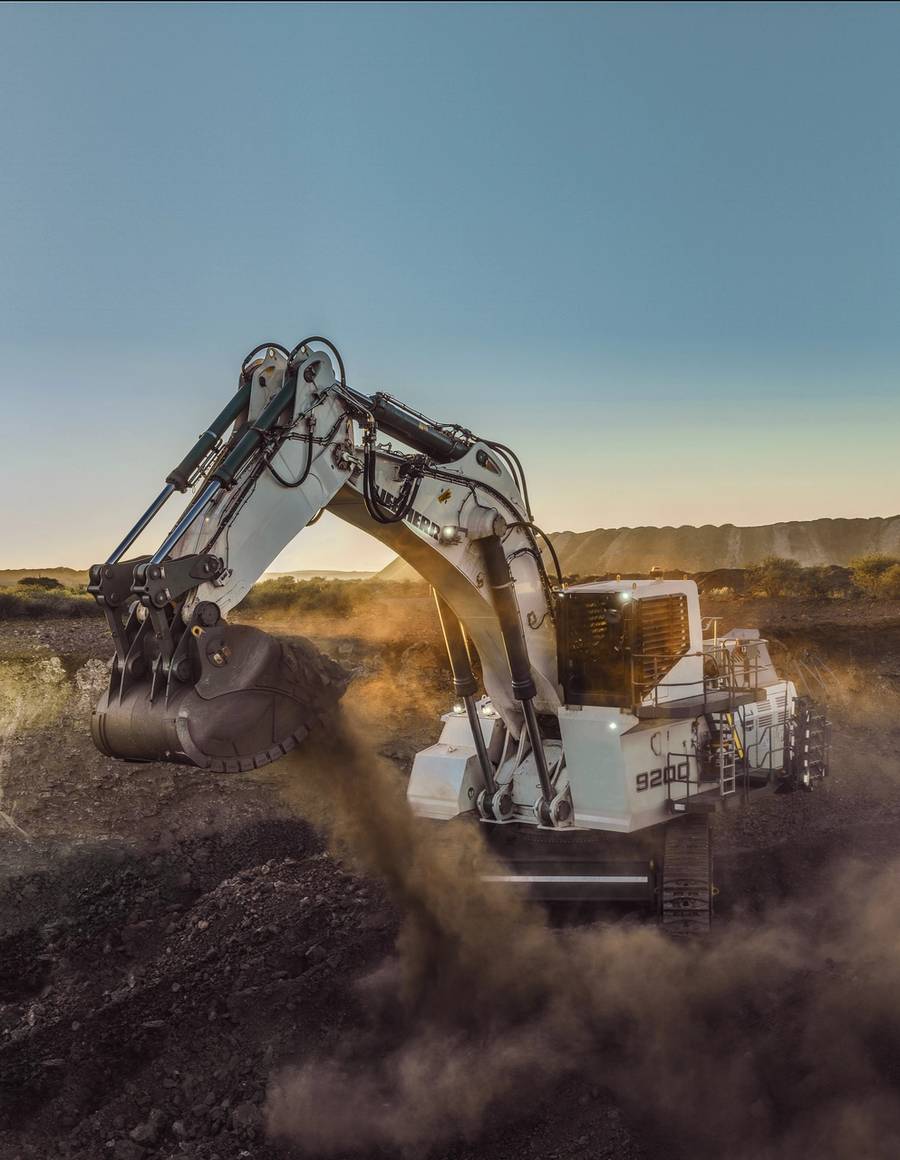
Image: Liebherr, Germany/Switzerland

Liebherr Confirms Ten-Machine Diesel Mining Fleet Now Fully Delivered To Indonesia's Darma Henwa

A plain reminder that large-scale coal mining in Southeast Asia still runs on diesel iron, in a market this newsroom is working to cover more.

Liebherr Indonesia says mining services contractor Darma Henwa has now taken delivery of ten machines, four R 9200 crawler excavators and six PR 776 dozers, split between its Bengalon site in East Kalimantan and Kintap in South Kalimantan. Deliveries ran from the third quarter of 2025 through to April 2026, with three of the ten being Generation 8 models.

Liebherr now counts 17 machines at Bengalon and four at Kintap in total. Bengalon operations manager Arofik Anwar praised the R 9200's fuel efficiency and structural strength since arrival.
Primary source: HeavyQuip Magazine · 28 October 2026
Back to the Diesel Industry News homepage
Desk 4 · Marine, Rail, Defence & Power
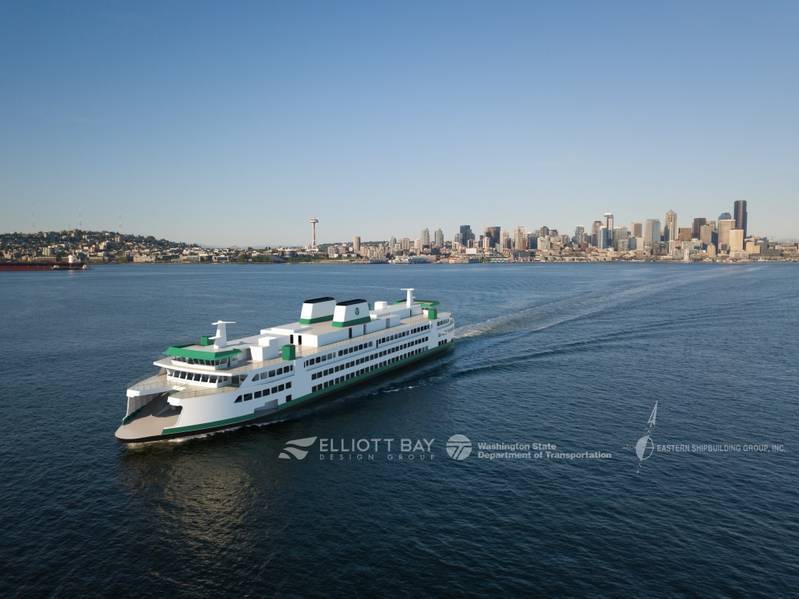
ABB Locks In Third Diesel-Battery Plug-In Hybrid Ferry For Washington State Fleet
Image: ABB, Switzerland/Sweden (via press materials)

ABB Locks In Third Diesel-Battery Plug-In Hybrid Ferry For Washington State Fleet

A genuine, verified diesel-hybrid signature find: a plug-in hybrid vehicle-ferry programme scaling from two vessels to three, with the diesel/battery split explicitly confirmed by the operator.

ABB has received a Notice to Proceed from Washington State Ferries to supply and integrate the power and propulsion system for a third hybrid-electric newbuild ferry, expanding its scope from two vessels to three. The vessels are being built by Eastern Shipbuilding Group in Florida, part of Washington State Ferries' plan for up to 16 hybrid-electric ferries by 2040, each carrying 160 vehicles and around 1,500 passengers.

ABB's system centres on an Onboard DC Grid and Power and Energy Management System, paired with a 13.2MWh Corvus battery bank. Washington State's own transport department confirms the vessels keep two diesel engines alongside two battery banks, switching between diesel, battery-only and hybrid modes, with rapid charging built into each terminal stop. First delivery is slated for 2030.
HYBRID LEVEL: PLUG-IN / PHEV: diesel engines retained for range and open-water running, 13.2MWh battery bank charges via rapid shore charging, genuine electric-only mode on short routes and in port.
Primary source: MarineLink · 29 October 2026
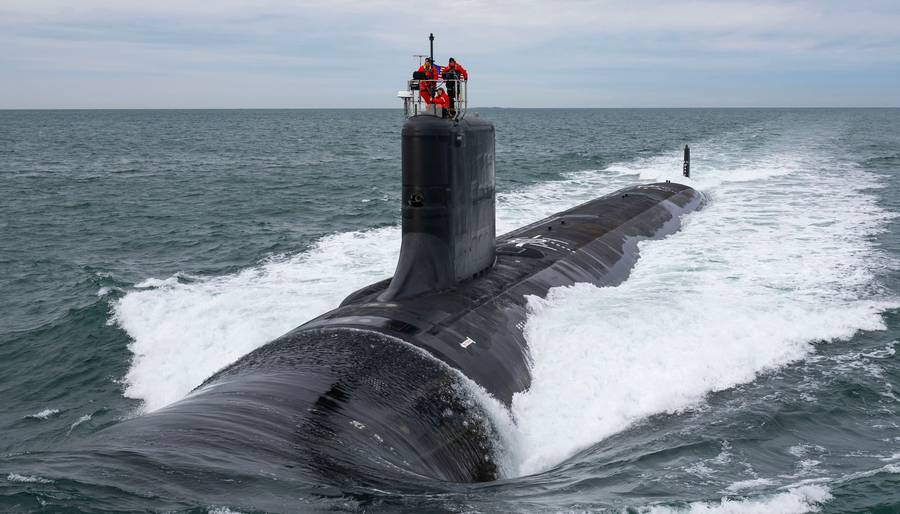
Fairbanks Morse Defense Wins $99M NAVSEA Contract For Submarine Emergency Diesel Generator Overhauls
Image: Fairbanks Morse Defense, USA

Fairbanks Morse Defense Wins $99M NAVSEA Contract For Submarine Emergency Diesel Generator Overhauls

Confirmed, explicit diesel hardware on US Navy nuclear submarines, real diesel-industry news from the defence sector with the diesel component named outright.

Fairbanks Morse Defense has won a sole-source, $99.09 million follow-on contract from Naval Sea Systems Command for repair, parts and labour covering Emergency Diesel Generator overhauls on six nuclear submarines, a mix of Ohio-class and Los Angeles-class boats. The work supports the Navy's push to extend these submarines' service lives by up to 14 years, running through 2030.

FMD says it will use a robotic welding platform, cutting manual welding time by up to two-thirds, and its "Pit Stop" methodology, co-developed with the Navy, to compress depot maintenance from months to weeks.
Primary source: Fairbanks Morse Defense · 27 October 2026
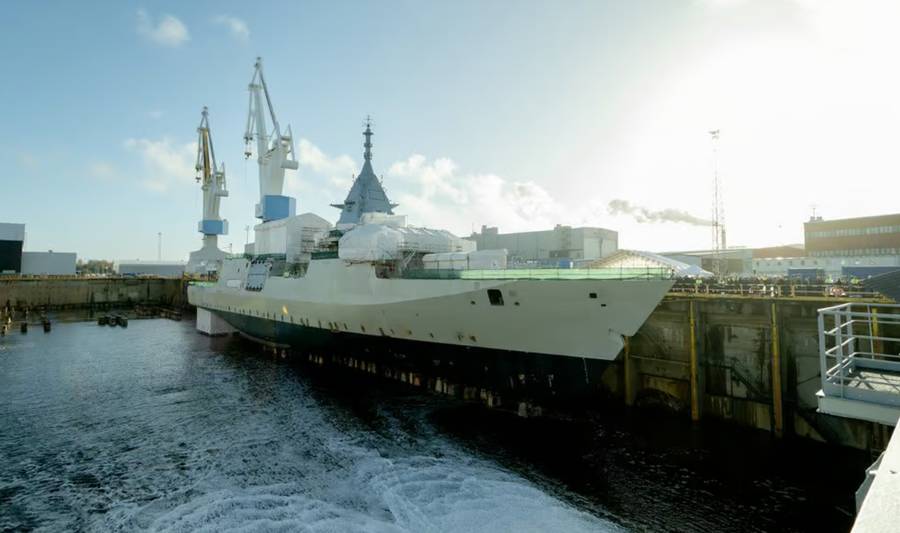
Finland Launches Third Pohjanmaa-Class Corvette, Diesel-Electric Plus Gas Turbine
Image: Rauma Marine Constructions, Finland

Finland Launches Third Pohjanmaa-Class Corvette, Diesel-Electric Plus Gas Turbine

A confirmed diesel-electric (CODLAG) warship launch for the Finnish Navy's flagship Squadron 2020 programme, verified against independent spec data rather than assumed from vessel class.

Rauma Marine Constructions has launched the third of four Pohjanmaa-class multi-purpose corvettes being built for the Finnish Navy's Squadron 2020 project at its Rauma Shipyard. The first two hulls are at the outfitting stage, the fourth had its keel laid in August. Saab supplies the combat and weapon systems.

The class uses CODLAG (combined diesel-electric and gas) propulsion: four MAN 12V175D diesel generating sets power the twin controllable-pitch propellers via electric motors for normal operations, with a single GE LM2500 gas turbine engaging through a common gearbox for speeds above 26 knots.
Primary source: Naval Today · 29 October 2026
Back to the Diesel Industry News homepage
Desk 8 · Regulation & Policy

UK Freezes Fuel Duty Again, Diesel Stays At 52.95p A Litre Through To July 2027 FINAL

Resolves the open UK fuel duty question, confirms no near-term relief or rise for haulage operating costs or at the pump for at least the next eight months.

New Chancellor John Healey used his first Budget to freeze fuel duty for a fifteenth straight year, extending the 5p a litre wartime cut that was due to start unwinding in January. Petrol and diesel both stay at 52.95p a litre. The scheduled 3p rise for January and a further 2p rise for March have been scrapped, with the freeze now locked in to July 2027.

Healey framed it as support for households, hauliers and farmers, as diesel prices sit near record highs.
Workshop/fleet impact: Nothing changes at the bowser for UK fleets right now. The increases everyone was braced for from January and March have been cancelled, so operators can plan fuel budgets on current rates until at least mid 2027.
Primary source: CityAM · 28 October 2026

EU Auto Package: Committees Vote To Soften The 2035 Combustion Ban To A 95% Cut PROPOSED

The first formal committee-level vote on the EU's long-anticipated dilution of its 2035 zero-emission car mandate, a signal Brussels is moving toward letting some combustion and diesel-hybrid technology survive past 2035.

The European Parliament's Industry (ITRE) and Transport (TRAN) committees have voted to back a cross-party compromise that would cut new-car CO2 emissions by 95 per cent by 2035 against 2021 levels, rather than the Commission's original 100 per cent, effectively a reprieve for a narrow slice of combustion technology. Manufacturers could stretch compliance to as low as 87.5 per cent of the cut if they use European-made "green steel."

Neither vote is binding law. The lead Environment Committee vote is still pending with no firm date, followed by a full Parliament plenary vote and a qualified-majority Council vote. Changes remain possible throughout.
Workshop/fleet impact: Nothing changes at the pump or in the showroom yet. If this compromise survives the remaining votes, European carmakers would face a 95 per cent (not 100 per cent) CO2 cut by 2035, worth watching for OEMs weighing continued diesel-hybrid investment in the EU.
Primary source: electrive.com · 22–23 October 2026

Thailand Cuts Excise Tax On Diesel-Biodiesel Blend B20 By 5.52 Baht A Litre For Three Months FINAL

A real, costed, final government decision that drops diesel (B20 blend) retail prices by 3.69 baht a litre overnight, aimed at truckers, farmers and transport operators as global crude stays volatile.

Thailand's Cabinet approved a three-month cut to the excise tax on B20 diesel (20% palm biodiesel blend) from 5.953 to 0.431 baht per litre. The change took effect at midnight on 28 October 2026 and runs to 27 January 2027, when the government will decide whether to extend it. At the pump, B20 diesel drops from 37.19 to 33.50 baht a litre.

The Excise Department, under PM Anutin Charnvirakul's cabinet, says the move eases cost-of-living pressure from Middle East-driven crude price swings and boosts demand for palm oil, cassava and sugarcane used in the blends.
Workshop/fleet impact: Fleets and farm operators running B20-rated engines get an immediate, if temporary, cost saving of roughly 3.69 baht a litre at the pump. Anyone unsure whether their engine is B20-rated should check their manual or dealer before switching blends.
Primary source: Thai Publica · 27 October 2026

Russia Locks In Diesel Export Ban Through January, Quietly Quadrupling The Diesel It Will Actually Let Out FINAL

Moscow's call on how much diesel it lets leave the country feeds straight into freight, bunker and pump prices everywhere else, because Russia is still one of the world's biggest diesel exporters even mid-ban.

Russia's government has confirmed it has signed off on extending its diesel export ban through to the end of January 2027, keeping the formal lid on shipments in place. But the real news is in the exceptions: officials are widening the quota system that lets specific refiners export anyway, and Deputy PM Alexander Novak says November's allowed volume will jump to around 2.15 million tonnes, up from roughly 500,000 tonnes in October.

The jump is tied to a diesel supply deal Moscow struck with Washington after a Putin-Trump call, part of a wider energy ceasefire arrangement with Ukraine that has let Russian refineries lift output.
Workshop/fleet impact: More Russian diesel is set to reach export markets in November than in October, roughly quadruple, which should take some heat out of tight global diesel supply, but the supply is still fully rationed by Moscow and could be throttled back again without notice.
Primary source: The Moscow Times · 29–31 October 2026
Back to the Diesel Industry News homepage
Watch List: next issue
Enjoying the paper? Get every edition free by email, straight from the newsroom. Subscribe here.
Back to the Diesel Industry News homepage